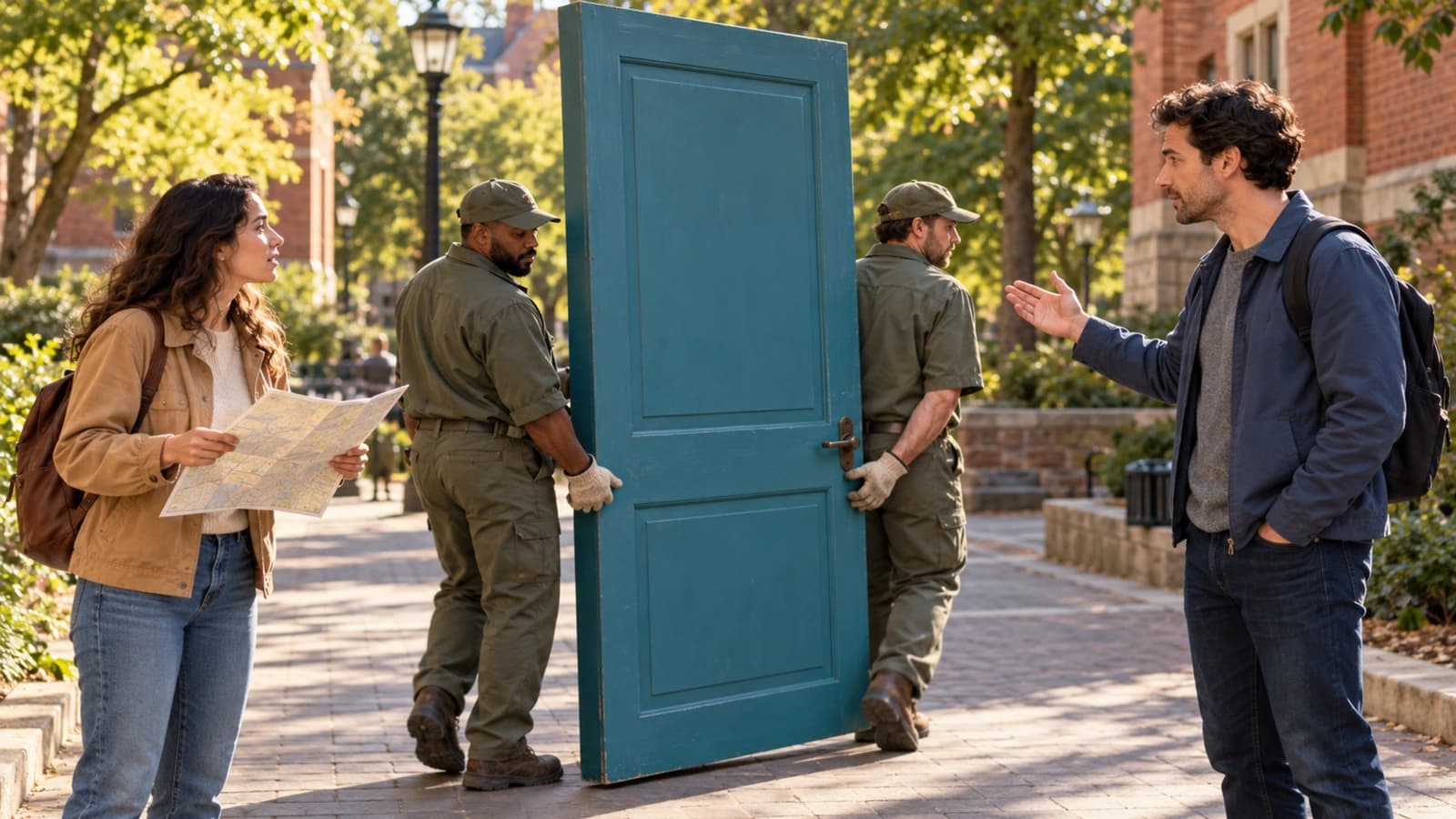
Cover: an AI-generated illustration of an interrupted conversation, inspired by the door study. It is not a photograph of study participants or a change-detection test.
A scene can change substantially without us noticing. Psychologists call this change blindness: difficulty detecting a difference between views of a scene, particularly when something interrupts or masks the moment of change.
The finding becomes interesting when the change is easy to see once someone points it out. The problem is not always that the detail was tiny or the picture unclear. Detecting a change also depends on how information from different moments is selected, retained and compared.
First, make the change happen again and again
In Rensink, O’Regan and Clark’s 1997 experiments, original and altered photographs repeatedly alternated, separated by brief blank fields. An object could change colour, position or presence. Observers knew that something would change and had to identify it.
Each experiment involved ten observers, who completed practice trials before testing. Large changes could take repeated alternations to locate. Changes involving objects independently judged central to a scene’s interest were found more quickly than changes to other details. A valid verbal cue also sped detection.
The blank disrupted the local visual signal that would normally draw attention toward the changing place. Looking through the sequence became a search rather than an immediate response to a visible transition.
This was a controlled image task. Its strength was that researchers could repeat the same change and vary the conditions. Its limits include small samples and a deliberately unusual display. It cannot supply a general percentage of everyday events that people miss.
Then, interrupt an ordinary conversation
Simons and Levin’s 1998 study moved the question outdoors. An experimenter asked a pedestrian for directions. Two people carrying a door passed between them, briefly blocking the view. During that interruption, a different experimenter took over the conversation.
In the first experiment, 7 of 15 pedestrians reported the switch when asked whether anything unusual had happened. One additional person claimed to have noticed after a direct prompt. In a second experiment, with the experimenters dressed as construction workers, 4 of 12 reported it before direct prompting; three more later claimed to have noticed.
Those distinctions matter. A general question and a prompt revealing the switch are different ways of asking. These small samples also do not justify saying that half of everyone would miss a person changing.
The interaction involved giving directions, a map and an unusual interruption. Those features may have influenced what participants noticed or reported. The authors explored social-group explanations, but the study does not establish a universal rule about whom we recognise.
A missed change does not settle what was remembered
It is tempting to jump from “the person did not report the switch” to “the original person left no memory at all.” Later work made that inference harder to defend.
In Simons, Chabris, Schnur and Levin’s 2002 experiments, people sometimes retained information about the original scene despite missing a change. Prompting could reveal details that had not produced a spontaneous change report. The paper examined three real-world experiments rather than assuming that detection alone measured everything a person remembered.
That finding does not establish a complete inner recording. It shows why failure to notice and failure to retain any information need separate tests. Someone might preserve a feature without making the comparison needed to identify what changed.
A 2005 review by Simons and Rensink develops this caution: change-blindness findings alone cannot determine whether visual representations are absent or sparse. To explain a particular result, researchers need evidence about the information available and the processes used to compare it.
Three questions that an impressive demonstration can blur
The experiments become easier to interpret when we separate three questions:
- Was the changing feature selected for attention? Knowing something will change does not tell an observer where to look. A useful cue can narrow the search.
- Was information about the earlier view available? A later failure to report a difference cannot answer that by itself. Recognition or prompted description can ask a different memory question.
- Was the difference detected and reported? Holding some relevant information does not ensure that someone compared the right features or described the result.
These are questions for evaluating an explanation, not a proven three-stage sequence or a personal attention test. Different tasks can fail for different reasons.
They also show why “pay more attention” is an incomplete account. In the door study, participants were interacting with the person who changed. Attending to a conversation does not guarantee detailed comparison of every feature of the speaker across an interruption.
Change blindness and inattentional blindness ask different questions
Change blindness concerns detecting a difference across views. Inattentional blindness concerns failing to notice an unexpected object or event while attention is occupied elsewhere. The two are often discussed together because both challenge confidence in noticing, but a finding about one should not be silently substituted for the other.
The distinction is especially clear in the photograph experiments: observers expected a change and actively searched for it. Their task was not simply to notice an unexpected object while doing something unrelated.
What these studies can add to everyday thinking
The useful lesson is to be more specific about what noticing requires. An uninterrupted look, a memory of a scene, a correctly detected difference and a confident report are related achievements, but they are not interchangeable evidence.
For an ordinary document comparison, placing two versions beside each other or naming the feature to compare changes the task. That is a practical illustration of making comparison explicit, not a tested guarantee drawn from the door experiment.
The research also gives little basis for blaming someone’s character because they missed a change. It does not diagnose a visual or memory condition, measure how much another person cares, or make all observations unreliable.
Our attention guide considers everyday conditions that can affect concentration. Our article on curiosity and memory asks another question about selection: whether interest in one answer helps us remember information encountered alongside it.
The surprising part of change blindness is not that people sometimes overlook things. It is how much the result depends on the moment between seeing one version of a scene and seeing the next.
About this article
Published by PsychPod. Evidence checked 27 October 2026. Prepared with AI-assisted writing and editorial source checking. Educational psychology, not an individual assessment or treatment guide. No independent clinical review is claimed.