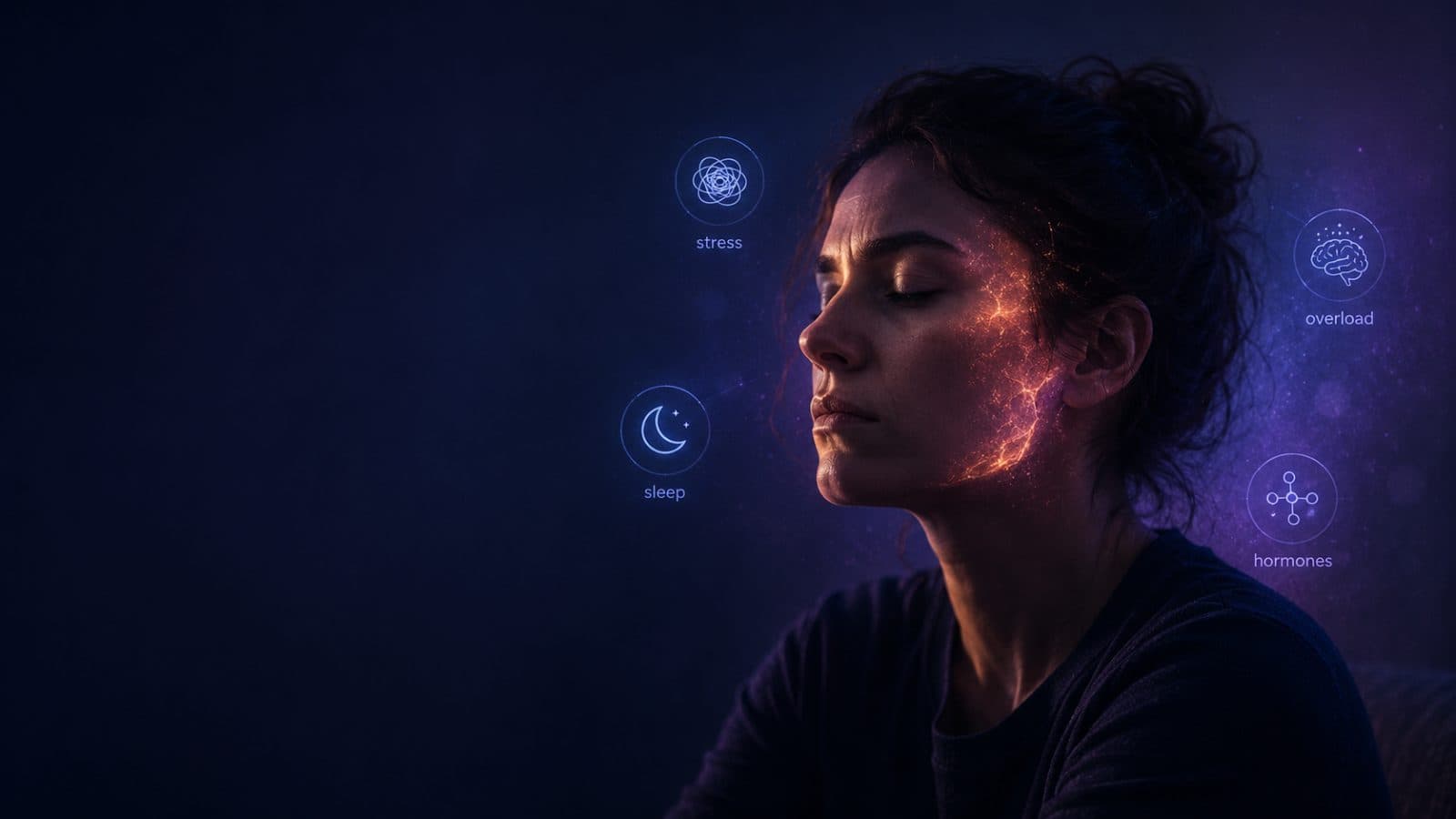
Some weeks, everything grates. The slow walker in front of you. The way someone chews. A harmless question from someone you love, answered with a sharpness that surprises even you. Afterwards you think, that was not really about them, and you are usually right. Something has lowered your threshold, and small things are getting through that normally would not.
Irritability is easy to treat as a character flaw or a bad attitude. It is more useful, and more accurate, to treat it as a state. States have causes. And the causes of a short fuse are surprisingly physical, which is good news, because physical causes are easier to do something about than a personality you are stuck with.
This piece is about what irritability actually is, why poor sleep, hunger, and ongoing stress quietly shorten your fuse, and why the people who get the sharp edge are often not the reason for it.
What irritability actually is
Irritability has a clearer definition than most people expect. In a 2017 review in Clinical Psychology Review, Michael Toohey and Raymond DiGiuseppe described it as a mood of partial physiological agitation, marked by increased sensitivity to stimuli and a lowered threshold for responding with anger to things that would not normally bother you that much. Notably, they pointed to causes that act directly on the body, including hunger, lack of sleep, pain, and fatigue.
Two things in that definition matter. First, irritability is about the threshold, not the trigger. The annoying thing is rarely the real story. What has changed is how little it now takes to provoke a reaction. Second, irritability is one of the most common symptoms in all of mental health. It appears as a feature of many different conditions, which is part of why it is so easy to misread. It is not a diagnosis. It is a signal that something underneath has shifted.
That reframing takes some of the moral weight off. A short fuse is usually less about who you are and more about the state your body and brain are currently in.
Why poor sleep shortens your fuse
If there is one reliable way to make almost anyone more irritable, it is to take away their sleep.
A well-known 2007 study by Seung-Schik Yoo, Matthew Walker, and colleagues in Current Biology scanned people after a normal night and after a night of sleep deprivation. Without sleep, the amygdala, a region central to threat and emotional reactivity, responded about 60 percent more strongly to negative images. Just as importantly, the normal connection between the amygdala and the prefrontal cortex, the part of the brain that helps keep emotional responses in proportion, was weakened.
That combination is the neural recipe for a short fuse. The alarm system is louder, and the brake that normally moderates it is looser. The result is not that tired people invent things to be annoyed by. It is that the same minor irritation now lands harder and is harder to wave off. This is why a single bad night can leave you snapping at things you would shrug off after good sleep, and why chronic poor sleep quietly raises the baseline level of irritability for weeks at a time.
Why hunger turns into anger
The word hangry started as a joke, but the underlying effect is real and has been studied.
A 2022 experience sampling study published in PLOS One followed people through ordinary daily life and found that greater hunger was associated with greater feelings of anger and irritability in the moment, not just in a lab. Hunger genuinely does seem to lower the threshold in everyday settings.
The mechanism, though, is more interesting than a simple drop in blood sugar. A 2019 study by Jennifer MacCormack and Kristen Lindquist in the journal Emotion found that hunger was most likely to turn into anger when people were in a negative situation and were not aware that they were hungry. When people recognized the feeling as hunger, the effect faded. In other words, hunger seems to act like a volume knob on whatever you are already feeling, and naming it as hunger takes some of its power away. The honest version of the science is that the popular idea of a pure blood-sugar switch is too simple. Context and awareness matter a lot.
The practical point survives the nuance. If you find yourself unusually irritable, the question "when did I last eat" is worth asking before you assume the problem is the person in front of you.
Why ongoing stress keeps you on edge
Sleep and hunger explain the bad day. Chronic stress explains the bad month.
The prefrontal cortex is the part of the brain that lets you pause, weigh consequences, and respond rather than react. In a 2009 review in Nature Reviews Neuroscience, Amy Arnsten described how even fairly mild uncontrollable stress can rapidly impair prefrontal function, and how more prolonged stress produces lasting changes in the region. Under stress, the careful, regulating part of the brain effectively steps back, and more reactive, faster systems take over.
This is adaptive in a genuine emergency, where speed matters more than reflection. It is much less helpful across a long stretch of ordinary modern stress, where the same shift just leaves you with a thinner buffer between provocation and reaction all day long. When you are under sustained pressure, the brake is weaker by default. Things that would not normally reach you do, because the system that would usually filter them is running at reduced capacity. A short fuse during a hard period is not a failure of will. It is partly a predictable consequence of what stress does to the regulating brain.
Why it is often not about the people around you
Here is the part worth being honest about in both directions.
Because irritability is a state with physical drivers, the things that set it off are frequently not its real cause. The tired, hungry, stressed version of you reacts to a small request as if it were a big imposition. The person on the receiving end, often someone close and safe, reasonably assumes the reaction is about them. It usually is not. People tend to direct irritability at the people they feel safest with, which is why families and partners so often get the sharpest edges while colleagues get the polite version.
Naming this is not a free pass. The impact on the people around you is still real, and "I was tired" does not erase a sharp comment. But understanding that the fuse was already short before they did anything helps in two ways. It lets you take responsibility for the reaction without spiraling into self-criticism about being a bad person, and it points you toward the actual lever, which is usually the state underneath, not the latest trigger.
If irritability is persistent, out of character, and lasting for weeks rather than days, it is worth taking seriously, because ongoing irritability can also be a feature of depression, anxiety, and other conditions. That is a conversation worth having with a clinician rather than something to diagnose yourself.
What this can look like in daily life
Irritability tends to show up in recognizable patterns:
- snapping at small things and feeling disproportionate about it almost immediately
- a much shorter fuse on days after poor sleep or a skipped meal
- finding ordinary sounds, requests, or interruptions far more grating than usual
- being patient and measured at work, then sharp at home where it feels safe
- a steady background tension during stressful weeks that makes everything feel like too much
- regret after the fact, and a sense that the reaction did not match the trigger
Seen individually, each episode feels like it is about its trigger. Seen together, the pattern often points somewhere else entirely.
How to reflect on it
When you notice you are irritable, a few questions tend to be more useful than trying to force yourself to be nicer:
- How did I sleep last night, and over the past few days?
- When did I last eat, and could hunger be turning up the volume?
- What ongoing stress is running in the background right now?
- Is this person or situation really the cause, or just the thing that got through?
- Has this been a bad day, or a pattern lasting weeks?
The goal is not to excuse the reaction. It is to find the real lever. Most short fuses are downstream of something fixable, and you can usually do more about sleep, food, and stress load than you can about the urge to snap once your threshold is already low.
How PsychPod can help you notice patterns
PsychPod does not measure your sleep or your blood sugar. It tracks how you feel across daily life, which is exactly where the pattern behind irritability tends to hide.
Over a few weeks of short check-ins, useful patterns often surface:
- low calm scores clustering on days after poor sleep or high stress
- irritable, on-edge days lining up with specific weeks rather than appearing at random
- the connection between a run of hard days and a shorter fuse that you would never reconstruct from memory
- the difference in how you respond to the same demands on rested versus depleted days
The value is not in labeling yourself as irritable. It is in seeing that your short-fuse days are not random or proof of a bad temperament. They tend to follow the state you are in, and once you can see the pattern, you know where to intervene before you reach the point of snapping.
Key takeaways
- Irritability is best understood as a state, not a character flaw. It involves physiological agitation and a lowered threshold for anger, often driven by hunger, lack of sleep, pain, and fatigue.
- Poor sleep amplifies the brain's threat response and weakens the prefrontal brake, which is a direct neural recipe for a short fuse.
- Hunger reliably increases irritability in daily life, though the mechanism is more about amplifying existing negative feelings than a simple drop in blood sugar, and naming the hunger reduces the effect.
- Chronic stress impairs the prefrontal cortex that normally keeps reactions in proportion, leaving a thinner buffer between provocation and reaction across a hard stretch.
- The triggers are often not the real cause, and the people who get the sharp edge are frequently just the safest ones nearby. Understanding the state helps you take responsibility without self-blame and aim at the actual lever.
Sources
- Toohey MJ, DiGiuseppe R. Defining and measuring irritability: construct clarification and differentiation. Clinical Psychology Review, 2017. pubmed.ncbi.nlm.nih.gov
- Yoo SS, Gujar N, Hu P, Jolesz FA, Walker MP. The human emotional brain without sleep: a prefrontal amygdala disconnect. Current Biology, 2007. walkerlab.berkeley.edu
- Arnsten AFT. Stress signalling pathways that impair prefrontal cortex structure and function. Nature Reviews Neuroscience, 2009. nature.com
- MacCormack JK, Lindquist KA. Feeling hangry? When hunger is conceptualized as emotion. Emotion, 2019. pubmed.ncbi.nlm.nih.gov
- Swami V, et al. Hangry in the field: an experience sampling study on the impact of hunger on anger, irritability, and affect. PLOS One, 2022. journals.plos.org
Dr. Dawood Jehangir Togoo
