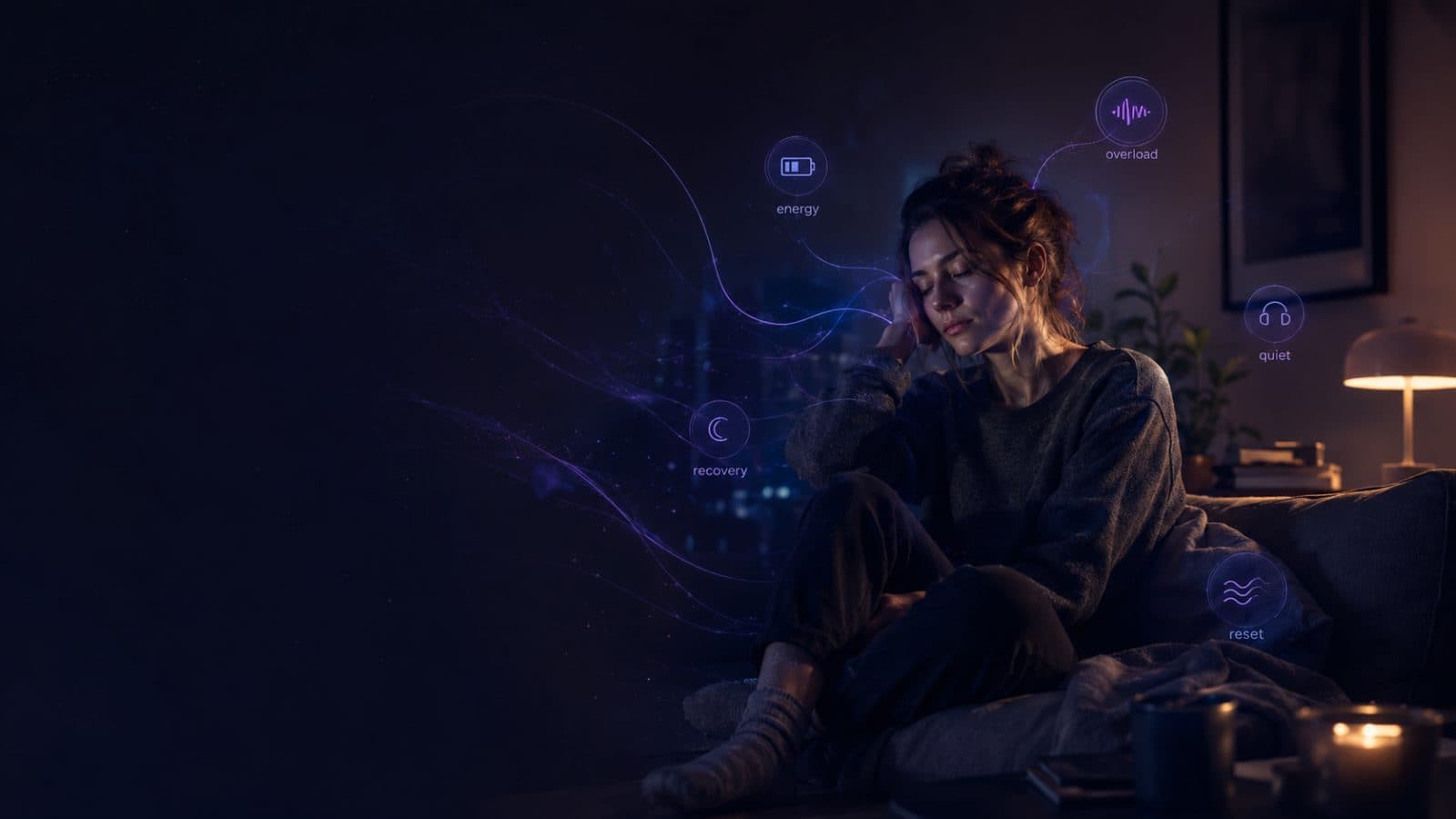
You had a good time. The people were lovely, the conversation was fine, nothing went wrong. And yet you come home feeling wrung out, a little foggy, faintly irritable, desperate for silence and a dark room. It can be confusing, even guilt-inducing. If you enjoyed it, why do you feel like you ran a marathon?
This is often called a social hangover, and it is a real and recognizable experience. It is not a sign that you dislike people or that something is wrong with you. Socializing genuinely costs energy, and for some people it costs a lot. Understanding why turns the experience from a personal failing into a predictable, manageable pattern.
This piece is about what a social hangover actually is, why interaction is more effortful than it looks, and why introverts and highly sensitive people feel the drain most.
What a social hangover actually is
A social hangover is the fatigue, depletion, and need for solitude that can follow a period of socializing, even enjoyable socializing. People describe feeling drained, foggy, flat, overstimulated, and unusually short-tempered, with a strong pull toward being alone and quiet to recover.
The popular metaphor is a social battery: a finite charge that social interaction draws down, and that solitude recharges. It is a metaphor rather than a literal organ, but it captures something accurate. Social energy is a limited resource for many people, the rate at which it drains varies a lot between individuals, and recovery generally requires a different kind of activity than the one that depleted it.
The key reframe is that the hangover is not about whether you liked the people. You can adore your friends and still be wiped out afterwards, because enjoyment and energy cost are two separate things.
Why socializing costs energy
From the inside, talking with people can feel effortless, but underneath, the brain is doing a lot of simultaneous work.
Social interaction demands continuous, fast processing. You are tracking what people say, reading tone and facial expressions, monitoring your own responses, managing how you come across, deciding when to speak, and regulating your reactions in real time. Much of this is automatic, but automatic does not mean free. It draws on attention, working memory, and self-regulation, the same limited resources that any demanding cognitive task uses.
There is also an emotional and self-presentational layer. In most social settings we do some degree of managing our image, holding back certain reactions, performing interest, and adjusting to the group. That effortful self-presentation is a form of work, and like any sustained effort, it depletes. By the end of a long social stretch, you have spent hours doing intensive real-time processing and self-regulation, so feeling tired afterwards is not strange. It is what you would expect from any extended effortful activity.
The cost also rises sharply with certain conditions. Unfamiliar people raise it, because you have less prediction to work with and more monitoring to do. Large groups raise it, because you are tracking many people and shifting between conversations. Higher stakes raise it, like a work event or meeting people you want to impress, because the self-presentation effort climbs. And for people who do a lot of masking, such as those who are socially anxious or neurodivergent, the regulation load can be heavier still, because they are continuously managing a gap between how they feel and how they are trying to appear. None of this shows on the surface, which is exactly why the resulting exhaustion can feel so unaccountable. The work was real, it was just invisible.
Why introverts feel it more
People differ enormously in how quickly socializing drains them, and a large part of that difference comes down to baseline arousal.
A long-standing theory by Hans Eysenck proposed that introverts and extraverts differ in their baseline level of cortical arousal. On this account, introverts run at a higher baseline level of internal arousal, which means they reach overstimulation sooner and are more easily pushed past their comfortable range by loud, busy, stimulating environments. Converging-measures research has supported the broad idea that introverts respond more strongly to stimulation. Extraverts, with lower baseline arousal, often need the extra stimulation of socializing to feel at their best, while introverts can hit overload from the same input.
This fits the lived experience precisely. A loud party that energizes one person leaves another frayed, not because one is better adjusted, but because their nervous systems are starting from different set points. A 2019 randomized controlled trial by Rowan Jacques-Hamilton, Jessie Sun, and Luke Smillie added a useful nuance: when people were asked to act more extraverted for a week, the more introverted participants gained less positive feeling and reported more tiredness and negative emotion than their extraverted counterparts. Acting outgoing has a steeper energy cost for introverts, which is exactly the social hangover in experimental form.
Why highly sensitive people feel it most
There is a related trait that intensifies the effect further: sensory processing sensitivity.
In foundational research published in 1997, Elaine Aron and Arthur Aron described sensory processing sensitivity, a trait found in a substantial minority of people who process sensory and emotional information more deeply and are more easily overwhelmed by intense or prolonged stimulation. For highly sensitive people, a social gathering is not just a social event. It is a flood of input: voices, faces, background noise, lighting, emotional undercurrents, all processed more deeply than average.
That deeper processing is often a strength, bringing richer perception and empathy, but it comes with a cost in busy environments. A highly sensitive person at a crowded, noisy event is doing more processing per minute than most, so they reach saturation faster and need more recovery afterwards. When sensory sensitivity and introversion overlap, as they often do, the social hangover can be especially strong. Importantly, this is a normal trait variation, not a disorder, and recognizing it usually brings relief rather than concern.
What this can look like in daily life
The social hangover tends to show up in recognizable ways:
- feeling drained and foggy after socializing you genuinely enjoyed
- a strong craving for silence, dim light, and being alone afterwards
- becoming quieter, flatter, or more irritable toward the end of a long social stretch
- needing a recovery day after big events, weddings, or conferences
- enjoying people in smaller doses but feeling overwhelmed by large or long gatherings
- feeling guilty about being tired, as if enjoyment should have prevented it
Each instance can feel like an inconsistency, enjoying something yet being exhausted by it. Together they reflect a simple truth: the enjoyment and the energy cost are separate, and for some people the cost is high.
How to reflect on it
If socializing reliably wipes you out, the useful questions are about understanding your own settings rather than forcing yourself to be different:
- How long can I socialize before the quality of my energy drops?
- Which settings drain me fastest, loud, large, unfamiliar, or prolonged ones?
- Do I need a recovery buffer after social events, and am I giving myself one?
- Am I confusing enjoying people with finding socializing effortless? They are not the same.
- What actually recharges me, and am I protecting time for it?
The aim is not to socialize less out of fear, but to plan around your real capacity. Knowing your limits, building in recovery time, taking quiet breaks during long events, and not scheduling demanding things right after big social occasions tend to help far more than pushing through and wondering why you are exhausted.
How PsychPod can help you notice patterns
PsychPod does not track who you see or for how long. It tracks how you feel across daily life, which is where the cost of socializing becomes visible over time.
Over a few weeks of short check-ins, patterns tend to surface:
- dips in energy or calm on the days after big or prolonged social events
- the difference between social settings that leave you depleted and ones that do not
- whether you are giving yourself enough recovery, or stacking demands on top of social fatigue
- a clearer sense of your real social capacity, rather than the one you think you should have
The value is in seeing your own pattern without judgment. When you can watch your energy reliably dip after certain kinds of socializing and recover with solitude, the social hangover stops feeling like a flaw and becomes simple, useful information about how you are built.
Key takeaways
- A social hangover is genuine post-socializing fatigue and overstimulation, separate from whether you enjoyed the company. Enjoyment and energy cost are not the same thing.
- Socializing is effortful. It demands continuous attention, social processing, and self-regulation, which draw on the same limited resources as any demanding task.
- Introverts tend to feel it more. Eysenck's arousal theory holds that they run at higher baseline arousal and reach overstimulation sooner, and acting extraverted is measurably more tiring for them.
- Highly sensitive people feel it most, because sensory processing sensitivity means deeper processing of stimulation and faster saturation in busy environments.
- The fix is planning around your real capacity, recovery time, quiet breaks, and not stacking demands on social fatigue, rather than forcing yourself to need less.
Sources
- Jacques-Hamilton R, Sun J, Smillie LD. Costs and benefits of acting extraverted: a randomized controlled trial. Journal of Experimental Psychology: General, 2019. pubmed.ncbi.nlm.nih.gov
- Eysenck's arousal theory of introversion-extraversion: a converging measures investigation. Journal of Personality and Social Psychology, 1993. pubmed.ncbi.nlm.nih.gov
- Aron EN, Aron A. Sensory-processing sensitivity and its relation to introversion and emotionality. Journal of Personality and Social Psychology, 1997. doi.org
Dr. Dawood Jehangir Togoo
