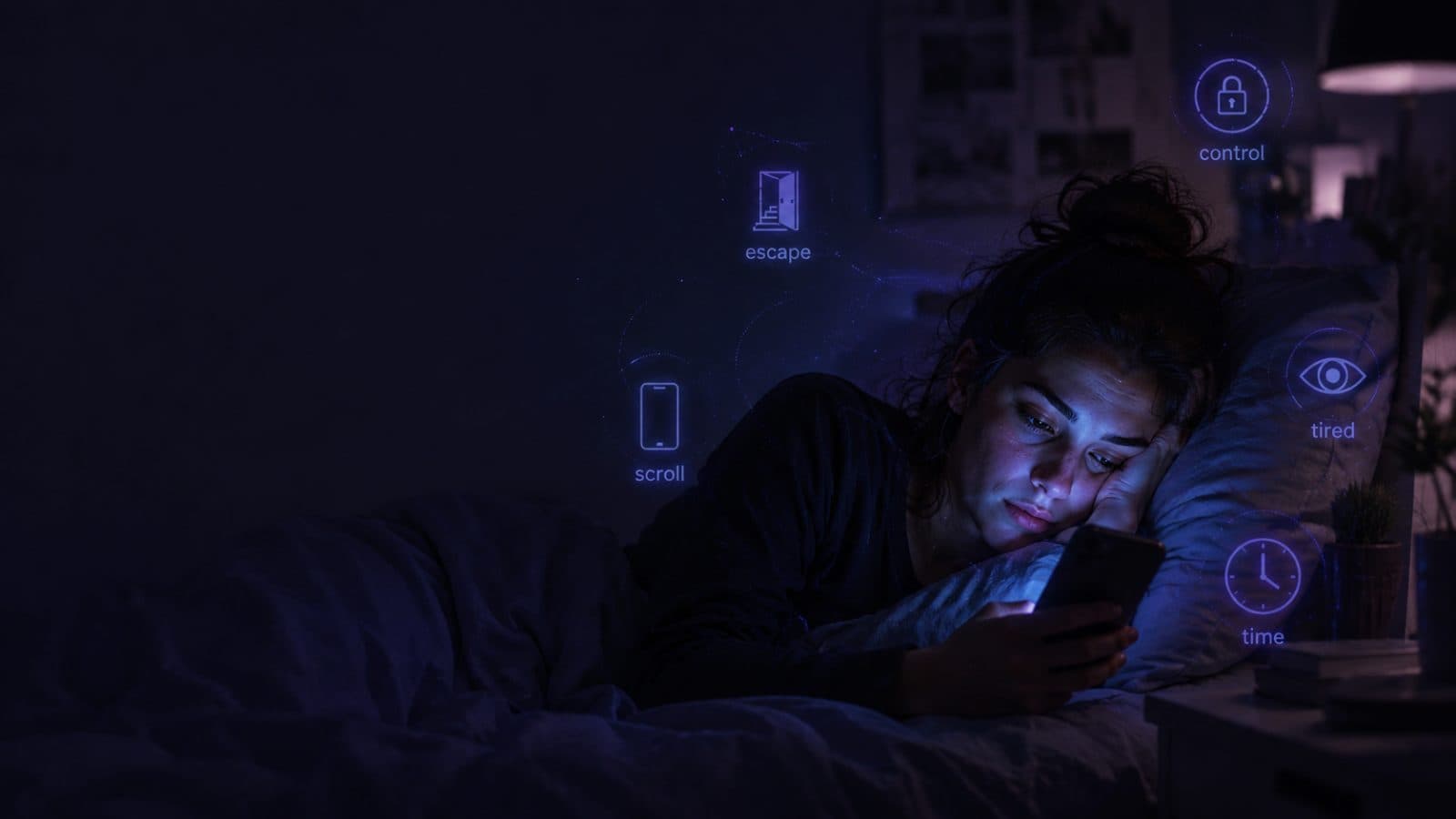
It is late. You are tired. You have known for an hour that you should go to bed, and tomorrow you will regret not having gone. And yet here you are, one more episode, one more scroll, one more anything that is not sleeping. Nobody is stopping you. There is no emergency. You just will not turn the lights off.
This pattern is common enough to have a name. Researchers call it bedtime procrastination, and the popular version, revenge bedtime procrastination, captures the feeling behind it: staying up to claw back some time for yourself after a day that did not leave you any. It is one of the few self-defeating habits where the person doing it can see exactly what they are doing and do it anyway.
This piece is about what bedtime procrastination actually is, why your willpower fails you at precisely the wrong moment, why the night can feel like the only time that belongs to you, and what tends to help.
What revenge bedtime procrastination actually is
Bedtime procrastination has a precise definition. In a 2014 paper in Frontiers in Psychology, Floor Kroese and colleagues defined it as failing to go to bed at the intended time, while no external circumstances prevent you from doing so. That last part is the key. This is not a parent up with a sick child or a worker on a late shift. It is delay with no outside cause, which means the obstacle is internal.
The "revenge" version adds the why. The phrase, which spread widely online, describes staying up late as a way of reclaiming a sense of control and leisure after a day that was entirely spoken for by work and obligations. If the whole day belonged to other people, the late evening becomes the only stretch that feels like yours, and giving it up to sleep can feel like surrendering the last bit of freedom you have.
Kroese and colleagues found that bedtime procrastination was linked to self-regulation. People who scored lower on general self-regulation tended to procrastinate on sleep more, and to get less sleep as a result. So the behavior sits at the intersection of two things: a genuine motivational pull to stay up, and a weakened ability to override it at the end of the day.
Why willpower runs out at night
The cruel timing of bedtime procrastination is not an accident. The capacity to make yourself do the boring, correct thing is usually at its lowest exactly when bedtime arrives.
Across the day, self-control takes effort, and that effort appears to deplete. By late evening, after a day of decisions, work, restraint, and demands, the mental resources you would use to follow through on a plan like "lights out at eleven" are running low. A 2018 study in Frontiers in Psychology by Bart Kamphorst and colleagues, titled around the idea of being too depleted to turn in, examined exactly this, finding that end-of-day depletion of self-control resources is relevant to why people procrastinate on going to bed. You are trying to make a disciplined choice at the precise moment you have the least discipline left.
This is why bedtime procrastination is so resistant to simply trying harder. The plan to sleep on time is made by your rested, rational daytime self. The plan is then handed to your depleted late-night self to execute, and that version of you is far more swayed by the immediate pull of one more episode than by tomorrow's wellbeing. The same logic explains why solutions that do not rely on late-night willpower, like setting the environment up earlier, tend to work better than resolve.
Why the night can feel like the only time that is yours
The motivational side deserves to be taken seriously rather than scolded, because it is usually pointing at something real.
If your days are densely scheduled, reactive, and full of other people's priorities, you may genuinely have no time in which you feel autonomous. The late evening is the gap. It is quiet, unscheduled, and free of demands, and the mind understandably treats it as precious. Choosing to stay up is, in part, a protest against a day with no slack in it, a way of insisting on a small territory of freedom even at a cost to tomorrow.
Understanding this changes the response. If bedtime procrastination is partly about a starved need for autonomy and rest, then the deeper fix is not more nighttime discipline but more breathing room in the day itself. People who manage to protect even small pockets of genuine personal time earlier on often find the late-night reclaiming loses some of its urgency. The need was legitimate. It was just being met at the worst possible hour.
Why some people are wired to delay
Not everyone is equally prone to this, and part of the difference is biological.
Chronotype, your natural tendency toward morningness or eveningness, plays a real role. In research by Roman Kadzikowska-Wrzosek and others on self-regulation and bedtime procrastination, evening types were found to be more likely to delay going to bed, partly through lower self-regulation of sleep behavior. Evening chronotypes are biologically inclined to feel alert later, yet most of them still have to wake to a morning-shaped world of early starts. That mismatch between an internal clock that wants to stay up and a social schedule that demands early rising sets up a nightly tension that bedtime procrastination slots neatly into.
This matters because it reframes the habit for night owls. If you naturally feel most awake and most yourself late at night, staying up is not simple weakness, it is partly your physiology arguing with your alarm clock. It does not remove the cost, but it points toward solutions that respect the chronotype, like consistent timing and managing light, rather than pure self-blame.
Why it costs more than the lost hour
It is tempting to treat the lost time as a fair trade, an hour of freedom for an hour of sleep. The exchange rate is worse than it looks.
The sleep that bedtime procrastination eats into is often the most restorative, and the next-day cost is broad. A 2010 meta-analysis by Julian Lim and David Dinges found that short-term sleep loss hits sustained attention and working memory hardest, the exact capacities you need to get through the next day well. So the reclaimed evening is paid for the following day with worse focus, lower mood, a shorter fuse, and less energy, which makes that day feel even more depleting and demanding, which makes the urge to reclaim the next evening even stronger. The pattern can become a self-reinforcing loop, where each tired day increases the pull to stay up the night after.
Naming the loop is useful. The late night does not actually repay the day. It borrows from tomorrow, and tomorrow charges interest.
What this can look like in daily life
Bedtime procrastination tends to show up in recognizable ways:
- knowing exactly what time you should sleep and routinely missing it for no real reason
- a feeling of mild defiance or relief in staying up, like claiming time back
- scrolling, streaming, or browsing well past the point of enjoying it
- a stronger pull to stay up after the busiest, most controlled days
- promising yourself an early night and then not taking it, repeatedly
- waking tired, resolving to do better, and repeating the same thing that night
Each night feels like a one-off choice. Across a couple of weeks, it usually reveals itself as a pattern tied to how the days are going.
How to reflect on it
If you want to shift this, the useful questions are about the day as much as the night:
- Do I have any time during the day that genuinely feels like mine?
- Am I staying up to do something, or just to not let the day end yet?
- What is my plan relying on, late-night willpower or an environment set up earlier?
- Am I a natural night owl fighting an early schedule, and can the schedule flex at all?
- What does tomorrow actually cost me when I do this, and is the trade honest?
The aim is to address the real need rather than just police the bedtime. Protecting small pockets of autonomy earlier, deciding the night before what the evening is for, and making the late-night options less frictionless tend to do more than resolving to have more willpower at midnight.
How PsychPod can help you notice patterns
PsychPod does not track your sleep or set alarms. It tracks how you feel across daily life, which is where the real cost and the real triggers of bedtime procrastination show up.
Over a few weeks of short check-ins, patterns tend to surface:
- low mood, focus, or energy days following the nights you stayed up against your own plan
- the link between the most demanding, least autonomous days and the strongest urge to stay up after
- a self-reinforcing loop where tired days feed late nights feed tired days
- the difference in how the next day feels when you do protect your sleep
The value is in seeing the trade honestly. When the cost of last night is laid out next to the day that follows, the late-night bargain looks a lot less appealing, and the days that actually need fixing become clearer.
Key takeaways
- Bedtime procrastination is failing to go to bed on time with no external reason. The popular "revenge" version captures the urge to reclaim personal time after a day with none.
- It is closely tied to self-regulation, and willpower is lowest late at night after a full day of effort, which is exactly when the disciplined choice is required.
- The night often feels like the only autonomous time in an overscheduled life, so the deeper fix is usually more breathing room in the day, not more nighttime discipline.
- Evening chronotypes are more prone to it, because an internal clock that wants to stay up collides with an early-rising social schedule.
- The lost sleep costs more than the reclaimed hour, worsening next-day attention, mood, and energy, which can lock the pattern into a self-reinforcing loop.
Sources
- Kroese FM, De Ridder DTD, Evers C, Adriaanse MA. Bedtime procrastination: introducing a new area of procrastination. Frontiers in Psychology, 2014. frontiersin.org
- Kamphorst BA, Nauts S, De Ridder DTD, Anderson JH. Too depleted to turn in: the relevance of end-of-the-day resource depletion for reducing bedtime procrastination. Frontiers in Psychology, 2018. frontiersin.org
- Kadzikowska-Wrzosek R. Self-regulation and bedtime procrastination: the role of self-regulation skills and chronotype. Personality and Individual Differences, 2018. sciencedirect.com
- Lim J, Dinges DF. A meta-analysis of the impact of short-term sleep deprivation on cognitive variables. Psychological Bulletin, 2010. ncbi.nlm.nih.gov
Dr. Dawood Jehangir Togoo
