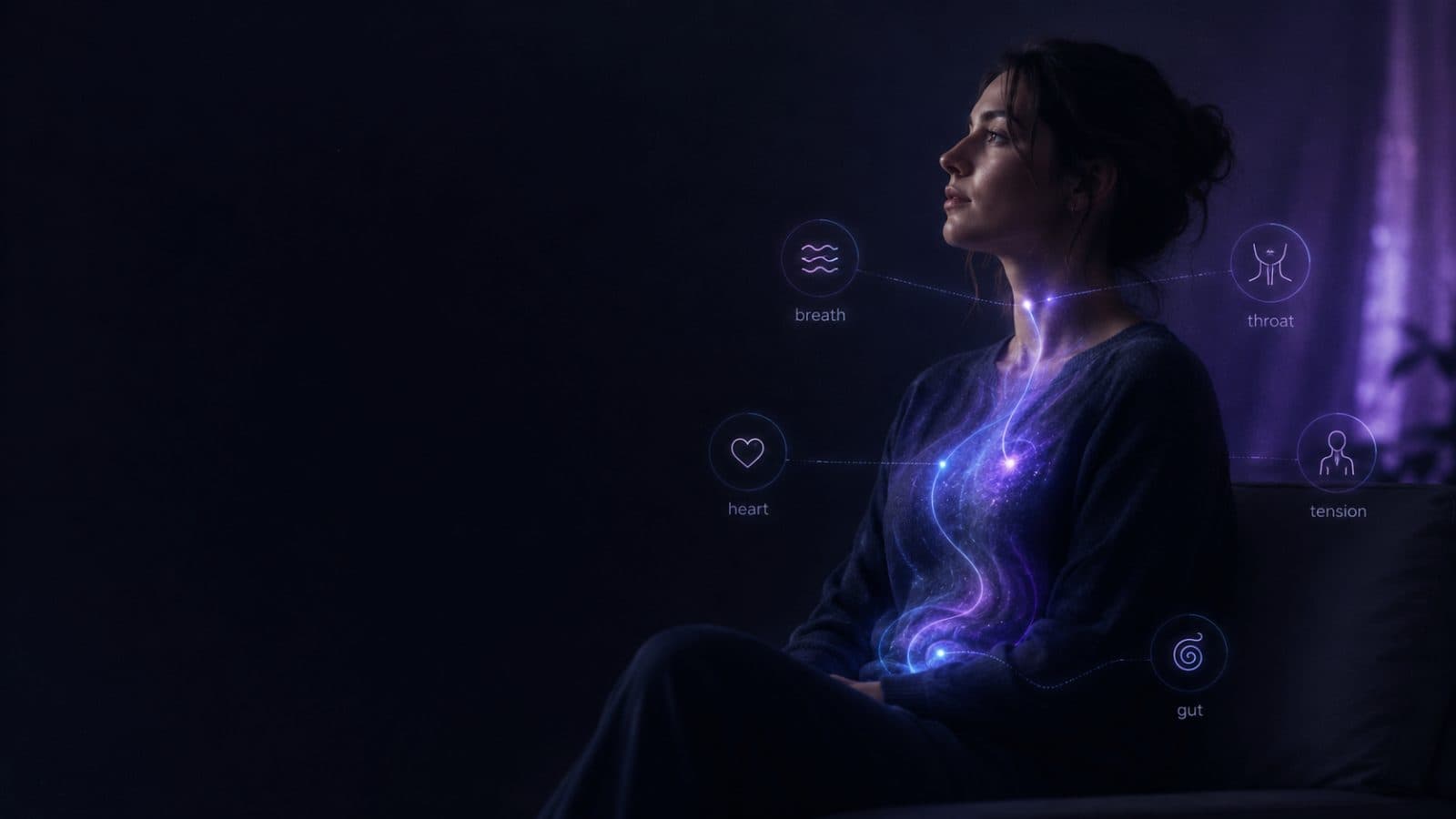
Anxiety is usually described as a feeling, something that happens in your thoughts. For a lot of people, that is not where it shows up first. It shows up in the chest, the stomach, the jaw, the hands. A heart that races in a quiet room. A knot in the gut before an email you have not even opened. Shoulders that have been tense since lunchtime without you noticing.
If your anxiety lives more in your body than in your head, you are not unusual, and you are not imagining it. The physical side of anxiety is one of the most well-documented parts of the whole picture. The symptoms are real, measurable, and they follow a logic that makes sense once you see it.
This piece is about why anxiety produces physical symptoms, why those symptoms can stick around longer than the worry that started them, and why paying attention to them can sometimes make them louder.
What physical anxiety symptoms actually are
Anxiety is a whole-body state, not just a mental one. When the brain registers something as a threat, it does not keep that information to itself. It sends signals down through the nervous system to the heart, lungs, gut, muscles, and skin.
The physical symptoms people report most often include a fast or pounding heartbeat, shortness of breath or a sense of not getting a full breath, chest tightness, muscle tension, trembling or shakiness, sweating, a dry mouth, nausea or other gut changes, dizziness, tingling in the hands, and a heavy fatigue that does not match how much you have done. The National Institute of Mental Health lists this kind of physical symptom alongside the more familiar worry and restlessness as a core part of how anxiety presents.
The important thing to hold onto is that these are genuine physiological events. The heart really is beating faster. The muscles really are tighter. Nothing about this is invented or exaggerated by the person experiencing it. It is the body doing something specific, for a specific reason.
Why anxiety switches the body on
The reason for all of this is the fight or flight response, run by the sympathetic branch of the autonomic nervous system.
When your brain perceives a threat, it triggers a fast cascade. The adrenal glands release adrenaline, and over a slightly longer timescale, cortisol. Heart rate and blood pressure rise. Breathing speeds up. Blood is redirected toward the large muscles. Digestion slows. Pupils widen. The muscles tense in readiness to move.
Each of these has an obvious survival purpose. A faster heart and quicker breathing push more oxygen to the muscles. Tense muscles are primed to run or fight. Slowed digestion explains the nausea and the unsettled gut, because the body has decided this is not the moment to process lunch. Sweating cools a body that is preparing for effort. Seen this way, the symptom list stops looking random. It is a coordinated package built to get an animal out of danger.
The catch is that this system evolved for short, physical emergencies. It was designed for the lion, not for the inbox, the group chat, or the slow worry about money that never quite resolves. The body cannot easily tell the difference between a genuine physical threat and a modern psychological one. So it runs the same ancient program in response to a difficult meeting, and you get a real physical reaction to a situation that no amount of running or fighting will fix.
Why the body can stay switched on
A healthy stress response is not just about switching on. It is about switching off again afterwards. The parasympathetic nervous system, carried largely by the vagus nerve, is the brake that brings the body back to rest once a threat has passed.
One useful window into how well this braking system is working is heart rate variability, the small natural variation in time between heartbeats. Higher variability tends to reflect a nervous system that can shift flexibly between alert and calm. Lower variability tends to reflect a system stuck closer to the alert end.
A 2014 meta-analysis by Chalmers and colleagues in Frontiers in Psychiatry found that anxiety disorders are consistently associated with reduced heart rate variability, with a small to moderate effect size across studies. In plain terms, the data suggest that in anxiety, the body's brake is less responsive than it could be.
There is a brain side to this too. The neurovisceral integration model, developed by Julian Thayer and colleagues, describes how the prefrontal cortex normally helps calm threat signals coming from deeper regions like the amygdala. A 2012 meta-analysis by Thayer and colleagues tied heart rate variability to activity in this network. When that top-down regulation is weaker, the body is left in a higher state of arousal for longer. This helps explain a common and frustrating experience: the physical symptoms outlasting the thought that set them off. The worry passes, but the tense shoulders, the restless stomach, and the slightly too-fast heart stay behind.
Why noticing the symptoms can make them worse
Here is the part that often surprises people. The way you pay attention to a physical sensation can change how intense it feels.
Interoception is the term for how we sense the internal state of the body, things like heartbeat, breathing, and gut signals. Research by Martin Paulus and Murray Stein, including an influential 2010 paper in Brain Structure and Function, suggests that anxious individuals tend to have an attentional bias toward these internal signals and a tendency to read them as more dangerous than they are. The body sends a normal signal, attention locks onto it, and the brain interprets it as a sign that something is wrong.
David Clark's 1986 cognitive model of panic describes how this can spiral. A normal bodily sensation, say a slightly fast heartbeat, gets interpreted catastrophically, for example as the start of a heart attack. That interpretation increases anxiety, which increases the physical arousal, which produces stronger sensations, which seem to confirm the fear. The loop feeds itself. Clark's key insight was that the trigger for panic is often not the sensation itself but the terrible meaning attached to it.
This is worth handling carefully, because it is easy to hear it as "it is all in your head." That is not the message. The sensations are real. What this research shows is that attention and interpretation sit on top of those real sensations and can turn the volume up or down. That is also why it can be useful, because the parts you can influence, attention and meaning, are not the same as trying to force your heart to slow down by willpower.
What this can look like in daily life
The physical side of anxiety tends to show up in patterns rather than as one dramatic event. A few common ones:
- a tight chest or restless stomach on Sunday evening, before the week has even started
- gut symptoms that reliably appear before specific situations, like presentations or difficult conversations
- jaw, neck, or shoulder tension you only notice when you finally sit down at night
- waking in the early hours with a pounding heart and no clear reason
- feeling tired and wired at the same time, too drained to act but too activated to rest
- physical symptoms that have been medically checked and found to have no clear physical cause
That last point matters. Persistent or severe physical symptoms, especially anything involving the heart, breathing, or significant gut changes, deserve a proper medical check first. Anxiety is a reasonable explanation only once the more direct physical causes have been ruled out by a clinician. Recognizing a pattern is helpful. Self-diagnosing away a symptom that needs attention is not.
How to reflect on it
If you want to understand your own physical anxiety, a few honest questions tend to be more useful than trying to suppress the symptoms:
- Where in my body do I tend to feel it first?
- What usually happens just before it starts?
- Is there a time of day, or a day of the week, when it shows up more?
- Am I reading these sensations as dangerous, or as uncomfortable but safe?
- Does the feeling ease once the situation passes, or does it linger long after?
The aim is not to interrogate yourself. It is to notice the shape of the thing. Most people are surprised by how predictable their physical symptoms become once they start paying attention to the pattern rather than reacting to each episode as if it came from nowhere.
How PsychPod can help you notice patterns
PsychPod does not measure your heart rate or your breathing. It tracks how you feel across daily life, which is often where the useful pattern actually lives.
Over a few weeks of short daily check-ins, some patterns tend to surface:
- calm scores that drop on particular days or in particular weeks
- the days you feel most physically on edge lining up with poor sleep or higher stress the day before
- a recurring weekly dip that you would never have spotted from memory alone
- stretches where your body settles, and what was different about them
None of this is a diagnosis, and PsychPod is not a medical tool. It is a way to see your own patterns over time instead of relying on a memory that tends to overweight the worst days. For something as physical and as easy to misread as anxiety, seeing the pattern can be the difference between feeling at the mercy of your body and understanding what tends to set it off.
Key takeaways
- Anxiety is a whole-body response. The physical symptoms, from a racing heart to a tense jaw to an unsettled gut, are real physiological events driven by the fight or flight response.
- These symptoms map onto survival functions designed for short physical emergencies, which is why they fire unhelpfully in response to modern psychological stress.
- The body relies on a braking system, supported by the vagus nerve. Anxiety is associated with reduced heart rate variability, which helps explain why arousal can linger after the worry has passed.
- How you attend to and interpret bodily sensations can amplify them. Clark's panic model and interoception research show that meaning and attention sit on top of real sensations and can turn the volume up.
- Persistent or severe physical symptoms should be checked medically first. Once that is done, noticing the pattern is usually more useful than fighting each episode.
Sources
- National Institute of Mental Health. Anxiety Disorders. nimh.nih.gov
- Clark DM. A cognitive approach to panic. Behaviour Research and Therapy, 1986. sciencedirect.com
- Paulus MP, Stein MB. Interoception in anxiety and depression. Brain Structure and Function, 2010. pmc.ncbi.nlm.nih.gov
- Chalmers JA, Quintana DS, Abbott MJ, Kemp AH. Anxiety disorders are associated with reduced heart rate variability: a meta-analysis. Frontiers in Psychiatry, 2014. frontiersin.org
- Thayer JF, Ahs F, Fredrikson M, Sollers JJ, Wager TD. A meta-analysis of heart rate variability and neuroimaging studies: implications for heart rate variability as a marker of stress and health. Neuroscience and Biobehavioral Reviews, 2012. sciencedirect.com
Dr. Dawood Jehangir Togoo
